The Milkmaid
Mar. 11th, 2016 01:25 pm![[personal profile]](https://www.dreamwidth.org/img/silk/identity/user.png) rayaso
rayasoIdol, Week 13
Topic: Life is Art
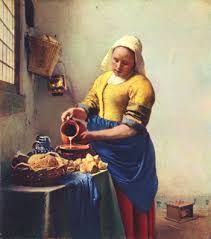
THE MILKMAID
The crowds worshipped her, wondering how the artist had made her so perfect. “You can almost see her breathe.” “She looks so real.” “I wonder who she was?” “I am here, still here,” the milkmaid wanted to scream. “I was one of you once!”
Christina had been a maid in the Vermeer household, in and out of the artist’s studio, seeing the great man paint and envying those who served as his models – no hard work for them! “Truly, no ordinary man can paint such masterpieces,” Christina had said to Neeltje, the cook. Other artists had spread rumors that her master had made a pact with the Devil for the souls of his models, but Christina had ignored them as mere whisperings of rival painters, bitter over lost commissions and jealous of Vermeer’s fame.
Then, one day, Vermeer had noticed Christina as she did her daily chores, and, having no commissions in hand, invited her to his studio. “Please, Christina, put aside your work,” her master had asked. “Let me make a sketch of you.” Christina had welcomed the relief from her drudgery, and so she had entered the studio.
“Stand here,” Vermeer had asked, “next to this table and hold this pitcher.” Vermeer had posed her precisely as he wanted, arms extended, pretending to pour milk into a bowl. The remains of a meal had yet to be cleared from the table.
Christina had stood for hours, holding still, watching her master out of the corner of her eyes, her arms and legs aching. At last Vermeer had released her, and she had finally been able to move her cramped muscles. “I will never again be jealous of the models,” Christina had thought, “for they work harder than any serving girl.”
“I have taken your likeness,” Vermeer had said, seeming to Christina to be pleased with his work, “and now, with your permission, I would like to make a portrait from this and capture you in paint.”
“Of course,” Christina had replied, honored by the request. “Will you need me again?”
To her great relief, her master had said only “I have what I need. Your presence is no longer necessary.”
Christina had visited the studio many times in the course of her duties, and had seen her likeness gradually emerge in the painting, which had pleased her and annoyed the other maids.
Eventually, Vermeer had invited her to see the finished portrait. Christina had been in awe of it, it was so very like her! And yet, Vermeer had been unhappy. “Something is missing,” he had said. “I failed to capture all of you.”
Tragically, Christina’s life had been cut short not long after the painting had been finished. She had died after being crushed by a runaway cart in the market.
After hearing the news, Vermeer had run to his studio, saying only, “It is done – it is perfect.” The portrait had now been imbued with the very soul of the poor maid.
For centuries, Christina had been passed from owner to owner, gallery to museum, until she had been hung in the Rijksmuseum, no one realizing the nature of Vermeer’s genius or seeing the selfish cruelty behind it. “I did nothing to deserve this Hell,” she had tried to say, until she had finally despaired, with only her prayers to comfort her.
Christina always noticed the magistrate when he returned and began to look forward to his visits with anticipation. She dreamed of meeting him, not as a milkmaid, but as a fine lady dressed in a luxurious gown.
The magistrate’s visits were irregular at first, but then they settled into a comfortable pattern. He would visit her on the last day of the month, not long before closing, when often it was just the two of them.
One day a miracle occurred. How it happened or why, Christina did not know, but she could hear the magistrate’s thoughts as he read! “This is not mere eavesdropping on the crowd,” she marveled, “but soul touching soul!
“Turning and turning in the widening gyre
The falcon cannot hear the falconer.”
Poetry! He reads poetry! Christina could have wept. The poem was grim and strange, but beautiful.
On and on the poetry flowed to Christina, and she was no longer alone.
“I will arise and go now, and go to Innisfree,
And a small cabin build there, of clay and wattles made.”
There were limits. “I cannot speak to him, and I am aware only of his poems,” Christina discovered, “but such beauty is enough.”
At times she could tell the magistrate’s mood from his poems.
“Into many a green valley
Drifts the appalling snow;
Time breaks the threaded dances
And the diver’s brilliant bow.”
Over time, though, his selections changed and became more revealing.
“Let me not to the marriage of true minds
Admit impediments. Love is not love
Which alters when it alteration finds,
Or bends with the remover to remove.”
“Love is troubling the magistrate,” thought Christina, “but for whom?”
Months faded into years, but still the magistrate came and read. Sometimes he was happy, and Christina rejoiced. Other times he was sad, and she pitied him, but always there was love. In rare moments, Christina thought he might be courting her, but quickly dismissed these thoughts.
“Had we but world enough and time,
This coyness, Lady, were no crime.”
Still, the magistrate would look at her, and sigh. “But it is for his own love,” she reminded herself.
One winter’s day, the magistrate did not sit on his bench, but approached Christina. From underneath his jacket, the magistrate drew a single red rose, held it up for her to see, and placed it on the floor beneath her. “Me,” Christina rejoiced, “it is me he loves!”
“Let me confess that we two must be twain,
Although our undivided loves are one.”
Every visit thereafter, the magistrate would give Christina a single red rose after finishing his poetry.
Christina dreamed of a day when she could speak with the magistrate, and all that they would say to each other, their hearts unburdened by her prison. She yearned for his touch, but she knew it was never to be. At times she would weep silently to herself, but then the magistrate would return, and his poetry would comfort her.
The years passed, and Christina noticed the magistrate’s graying hair, and still later, his halting steps. “All love ends in the grave,” she worried, “but not mine!” Yet still the magistrate read, and left his rose.
“My glass shall not persuade me I am old,
So long as youth and thou are of one date;
But when in thee time's furrows I behold,
Then look I death my days should expiate.”
The day came when the magistrate arrived and as he left her the rose, he stared deep into her eyes, and wept. “He will not return,” Christina knew. That day, the magistrate read only one poem through his tears.
“When you are old and grey and full of sleep,
And nodding by the fire, take down this book,
And slowly read, and dream of the soft look
Your eyes had once, and of their shadows deep.”
The magistrate did not return on his appointed day. Instead, a stranger brought a bouquet of fifty-three red roses, one for each year of their love, and placed them below Christina’s portrait, and left.
“My love has died,” Christina knew, and there was no one to comfort her, alone again in her empty world, and she cursed Vermeer. But at the same time, she knew that without him, she never would have met the magistrate, and never known their love. She thought of one of the magistrate’s poems.
“I count no more my wasted tears;
They left no echo of their fall;
I mourn no more my lonesome years;
This blessed hour atones for all."
In that moment, a second miracle happened.
To the casual observer, nothing in The Milkmaid changed, but to a few, it seemed as if a light had died, taking with it the ultimate perfection of Vermeer’s masterpiece. Christina was released at last to join with the magistrate, her soul uniting with his and transcending Vermeer’s unholy bargain, which had held her captive for so long.
“But as all several souls contain
Mixture of things, they know not what,
Love these mix'd souls doth mix again
And makes both one, each this and that.”
* * * * *
Topic: Life is Art
THE MILKMAID
It was a torment being frozen in a painting, with no life of her own, but such was the fate of Christina, who had been pouring endless milk into a perpetually empty bowl for over 350 years. Her soul was imprisoned in this cramped portrait, no bigger than 18”x16”. Empires had risen and fallen and the world had changed many times over, but not for her, never her, trapped in time forever.
The crowds worshipped her, wondering how the artist had made her so perfect. “You can almost see her breathe.” “She looks so real.” “I wonder who she was?” “I am here, still here,” the milkmaid wanted to scream. “I was one of you once!”
Christina had been a maid in the Vermeer household, in and out of the artist’s studio, seeing the great man paint and envying those who served as his models – no hard work for them! “Truly, no ordinary man can paint such masterpieces,” Christina had said to Neeltje, the cook. Other artists had spread rumors that her master had made a pact with the Devil for the souls of his models, but Christina had ignored them as mere whisperings of rival painters, bitter over lost commissions and jealous of Vermeer’s fame.
Then, one day, Vermeer had noticed Christina as she did her daily chores, and, having no commissions in hand, invited her to his studio. “Please, Christina, put aside your work,” her master had asked. “Let me make a sketch of you.” Christina had welcomed the relief from her drudgery, and so she had entered the studio.
“Stand here,” Vermeer had asked, “next to this table and hold this pitcher.” Vermeer had posed her precisely as he wanted, arms extended, pretending to pour milk into a bowl. The remains of a meal had yet to be cleared from the table.
Christina had stood for hours, holding still, watching her master out of the corner of her eyes, her arms and legs aching. At last Vermeer had released her, and she had finally been able to move her cramped muscles. “I will never again be jealous of the models,” Christina had thought, “for they work harder than any serving girl.”
“I have taken your likeness,” Vermeer had said, seeming to Christina to be pleased with his work, “and now, with your permission, I would like to make a portrait from this and capture you in paint.”
“Of course,” Christina had replied, honored by the request. “Will you need me again?”
To her great relief, her master had said only “I have what I need. Your presence is no longer necessary.”
Christina had visited the studio many times in the course of her duties, and had seen her likeness gradually emerge in the painting, which had pleased her and annoyed the other maids.
Eventually, Vermeer had invited her to see the finished portrait. Christina had been in awe of it, it was so very like her! And yet, Vermeer had been unhappy. “Something is missing,” he had said. “I failed to capture all of you.”
Tragically, Christina’s life had been cut short not long after the painting had been finished. She had died after being crushed by a runaway cart in the market.
After hearing the news, Vermeer had run to his studio, saying only, “It is done – it is perfect.” The portrait had now been imbued with the very soul of the poor maid.
For centuries, Christina had been passed from owner to owner, gallery to museum, until she had been hung in the Rijksmuseum, no one realizing the nature of Vermeer’s genius or seeing the selfish cruelty behind it. “I did nothing to deserve this Hell,” she had tried to say, until she had finally despaired, with only her prayers to comfort her.
* * * * *
Occasionally someone would stand out from the rude gawkers who stared at her. One gray day Christina noticed a well-dressed young man sitting on a nearby bench, holding a book, glancing at her from time to time as he read quietly to himself. He returned every few days, sitting on the same bench, and reading his books. “He must be a wise man,” Christina thought, “perhaps a magistrate.” In her loneliness, Christina ached to be able to talk with him.
Christina always noticed the magistrate when he returned and began to look forward to his visits with anticipation. She dreamed of meeting him, not as a milkmaid, but as a fine lady dressed in a luxurious gown.
The magistrate’s visits were irregular at first, but then they settled into a comfortable pattern. He would visit her on the last day of the month, not long before closing, when often it was just the two of them.
One day a miracle occurred. How it happened or why, Christina did not know, but she could hear the magistrate’s thoughts as he read! “This is not mere eavesdropping on the crowd,” she marveled, “but soul touching soul!
“Turning and turning in the widening gyre
The falcon cannot hear the falconer.”
Poetry! He reads poetry! Christina could have wept. The poem was grim and strange, but beautiful.
On and on the poetry flowed to Christina, and she was no longer alone.
“I will arise and go now, and go to Innisfree,
And a small cabin build there, of clay and wattles made.”
There were limits. “I cannot speak to him, and I am aware only of his poems,” Christina discovered, “but such beauty is enough.”
At times she could tell the magistrate’s mood from his poems.
“Into many a green valley
Drifts the appalling snow;
Time breaks the threaded dances
And the diver’s brilliant bow.”
Over time, though, his selections changed and became more revealing.
“Let me not to the marriage of true minds
Admit impediments. Love is not love
Which alters when it alteration finds,
Or bends with the remover to remove.”
“Love is troubling the magistrate,” thought Christina, “but for whom?”
Months faded into years, but still the magistrate came and read. Sometimes he was happy, and Christina rejoiced. Other times he was sad, and she pitied him, but always there was love. In rare moments, Christina thought he might be courting her, but quickly dismissed these thoughts.
“Had we but world enough and time,
This coyness, Lady, were no crime.”
Still, the magistrate would look at her, and sigh. “But it is for his own love,” she reminded herself.
One winter’s day, the magistrate did not sit on his bench, but approached Christina. From underneath his jacket, the magistrate drew a single red rose, held it up for her to see, and placed it on the floor beneath her. “Me,” Christina rejoiced, “it is me he loves!”
“Let me confess that we two must be twain,
Although our undivided loves are one.”
Every visit thereafter, the magistrate would give Christina a single red rose after finishing his poetry.
Christina dreamed of a day when she could speak with the magistrate, and all that they would say to each other, their hearts unburdened by her prison. She yearned for his touch, but she knew it was never to be. At times she would weep silently to herself, but then the magistrate would return, and his poetry would comfort her.
The years passed, and Christina noticed the magistrate’s graying hair, and still later, his halting steps. “All love ends in the grave,” she worried, “but not mine!” Yet still the magistrate read, and left his rose.
“My glass shall not persuade me I am old,
So long as youth and thou are of one date;
But when in thee time's furrows I behold,
Then look I death my days should expiate.”
The day came when the magistrate arrived and as he left her the rose, he stared deep into her eyes, and wept. “He will not return,” Christina knew. That day, the magistrate read only one poem through his tears.
“When you are old and grey and full of sleep,
And nodding by the fire, take down this book,
And slowly read, and dream of the soft look
Your eyes had once, and of their shadows deep.”
The magistrate did not return on his appointed day. Instead, a stranger brought a bouquet of fifty-three red roses, one for each year of their love, and placed them below Christina’s portrait, and left.
“My love has died,” Christina knew, and there was no one to comfort her, alone again in her empty world, and she cursed Vermeer. But at the same time, she knew that without him, she never would have met the magistrate, and never known their love. She thought of one of the magistrate’s poems.
“I count no more my wasted tears;
They left no echo of their fall;
I mourn no more my lonesome years;
This blessed hour atones for all."
In that moment, a second miracle happened.
To the casual observer, nothing in The Milkmaid changed, but to a few, it seemed as if a light had died, taking with it the ultimate perfection of Vermeer’s masterpiece. Christina was released at last to join with the magistrate, her soul uniting with his and transcending Vermeer’s unholy bargain, which had held her captive for so long.
“But as all several souls contain
Mixture of things, they know not what,
Love these mix'd souls doth mix again
And makes both one, each this and that.”
* * * * *
I am grateful to ![[livejournal.com profile]](https://www.dreamwidth.org/img/external/lj-userinfo.gif) halfshellvenus for beta reading this story, for her html wizardry, and for contributing the poem “I count no more my wasted years”.
halfshellvenus for beta reading this story, for her html wizardry, and for contributing the poem “I count no more my wasted years”.
Authors, titles and links to the complete poems are in the order in which they appear.
halfshellvenus for beta reading this story, for her html wizardry, and for contributing the poem “I count no more my wasted years”.Authors, titles and links to the complete poems are in the order in which they appear.
William Butler Yeats, “The Second Coming”
William Butler Yeats, “The Lake Isle of Innisfree”
W. H. Auden, “As I Walked Out One Evening”
William Shakespeare, Sonnet 116
Andrew Marvell, “To His Coy Mistress”
William Shakespeare, Sonnet 36
William Shakespeare, Sonnet 22
William Butler Yeats, “When You Are Old”
Elizabeth Akers Allen, "At Last"
John Donne, “The Ecstasy”


![[identity profile]](https://www.dreamwidth.org/img/silk/identity/openid.png)
no subject
Date: 2016-03-12 02:01 am (UTC)no subject
Date: 2016-03-12 02:33 am (UTC)no subject
Date: 2016-03-12 06:23 am (UTC)no subject
Date: 2016-03-12 03:05 pm (UTC)no subject
Date: 2016-03-12 06:32 am (UTC)no subject
Date: 2016-03-12 03:06 pm (UTC)no subject
Date: 2016-03-12 01:27 pm (UTC)no subject
Date: 2016-03-12 03:11 pm (UTC)no subject
Date: 2016-03-12 06:06 pm (UTC)Brilliant!
no subject
Date: 2016-03-12 06:10 pm (UTC)no subject
Date: 2016-03-13 11:30 am (UTC)indeed.
Clever!
no subject
Date: 2016-03-13 03:16 pm (UTC)no subject
Date: 2016-03-13 10:48 pm (UTC)no subject
Date: 2016-03-14 01:13 am (UTC)no subject
Date: 2016-03-14 02:04 am (UTC)no subject
Date: 2016-03-14 02:19 pm (UTC)no subject
Date: 2016-03-14 07:13 am (UTC)no subject
Date: 2016-03-14 02:21 pm (UTC)no subject
Date: 2016-03-14 02:06 pm (UTC)AW
no subject
Date: 2016-03-14 02:22 pm (UTC)no subject
Date: 2016-03-14 02:07 pm (UTC)no subject
Date: 2016-03-14 02:22 pm (UTC)no subject
Date: 2016-03-14 07:57 pm (UTC)no subject
Date: 2016-03-14 09:47 pm (UTC)no subject
Date: 2016-03-14 08:02 pm (UTC)no subject
Date: 2016-03-14 09:48 pm (UTC)no subject
Date: 2016-03-14 08:07 pm (UTC)no subject
Date: 2016-03-14 09:52 pm (UTC)no subject
Date: 2016-03-14 09:09 pm (UTC)I love the idea that two souls could connect over the centuries in this way. I worked on a concept album about a person being in love with a long dead woman based on a daguerreotype but was never able to make it work. I'm so pleased to see you capture this concept so skillful and engagingly. Its such a good idea and you really made the whole relationship sing.
This is not a song about being caught in a painting, but it is a song about the Mona Lisa's sister. At least the first verse.
no subject
Date: 2016-03-14 09:54 pm (UTC)no subject
Date: 2016-03-14 10:36 pm (UTC)no subject
Date: 2016-03-14 11:10 pm (UTC)no subject
Date: 2016-03-14 11:12 pm (UTC)no subject
Date: 2016-03-14 11:23 pm (UTC)no subject
Date: 2016-03-14 11:29 pm (UTC)Keep going....it's almost St. Paddy's - time for a good limerick or three!
no subject
Date: 2016-03-15 12:51 am (UTC)no subject
Date: 2016-03-15 06:35 am (UTC)no subject
Date: 2016-03-15 01:39 pm (UTC)